✍️ By Sebastian Hertlein | 📅 Updated: April 2026 | ⏱️ 8 min read
When deciding whether to focus on one platform for your marketing efforts, excellent advice comes with a caveat: unless you spend six months mastering the wrong one because you picked it based on where you felt comfortable, not where your customers actually buy. I’ve watched this happen more times than I can count. After supporting 200+ AI startups at AI NATION and delivering 100+ digital projects across industries, the pattern is painfully consistent: a marketing manager commits fully to Instagram because they personally love it, executes perfectly for 90 days, and then wonders why the B2B leads aren’t coming. The platform wasn’t wrong. The validation process was.
Here’s something our analysis of the top-ranking content on this topic revealed: the current leading pages on this subject average just 120 words of content total. Barely a paragraph. That tells you how thin the advice has been so far. You deserve a proper framework, not a vibe.
Quick Answer: Yes, focusing on one platform is a smart strategy for most SMB marketing managers, but only after a short validation phase confirms your actual buyers are active there. Single-platform focus reduces content management time by 50 to 70% and delivers measurable engagement within 30 to 60 days, compared to 90+ days when spreading across five or more channels.
📑 In This Article:
- Why Most “Focus on One Platform” Advice Gets It Backwards
- How to Actually Pick the Right Platform When You Focus on One Platform
- Why Single-Platform Focus Works Once You’ve Validated Your Choice
- What Does the Data Actually Say? Platform Benchmarks Compared
- Real-World Examples Across Industries
- The Sequential Focus Model: Your Practical Roadmap
- Risks and Limitations You Should Know
⚡ TL;DR – Key Takeaways:
- ✅ Single-platform focus cuts content management time by 50 to 70% and gets results 2x faster than multi-platform approaches, according to Techna Digital research.
- ✅ The biggest mistake SMBs make is choosing their platform based on personal preference rather than where their buyers actually spend time.
- ✅ Run a 2-week audience validation test across two platforms before committing fully. Use Buffer’s free tier to keep effort manageable during this phase.
- ✅ The best long-term strategy is sequential focus: master one platform, then systematically add a second using 70% repurposed content and automation tools.
Why Most “Focus on One Platform” Advice Gets It Backwards
Here’s the thing most guides completely skip: the decision of whether to focus on one platform is way less important than which platform you pick. And yet almost nobody addresses the selection criteria properly.
What most guides miss is the importance of workflow integration over individual tool features. Marketers get obsessed with the question of “one versus many” when the real question is “which one, and how do I know?” Picking one platform with conviction is disciplined focus. Picking the wrong one with the same conviction is just an efficient path to the wrong destination.
In my 26 years of digital product development, I’ve seen mid-sized B2B companies pour three months of focused LinkedIn effort into genuinely excellent content, only to discover their actual buyers were hanging out in niche Slack communities and industry email newsletters the whole time. The focus was admirable. The validation was missing.
HubSpot’s 2026 platform data shows that 68% of small businesses actively use 2 to 4 marketing platforms. That’s not because they ignored focus advice. It’s because successful businesses don’t stay single-platform forever. The focus on one platform phase is meant to be time-bounded and validated, not an indefinite commitment to one channel regardless of results.
So before we get into the benefits of single-platform focus (and there are real ones), let’s talk about how to choose the right one first. That’s the conversation nobody’s having.
How to Actually Pick the Right Platform When You Focus on One Platform
This is where the rubber meets the road. And honestly, I think most marketing managers skip this step because it feels slow. It isn’t. You can validate platform fit in two weeks with minimal effort.
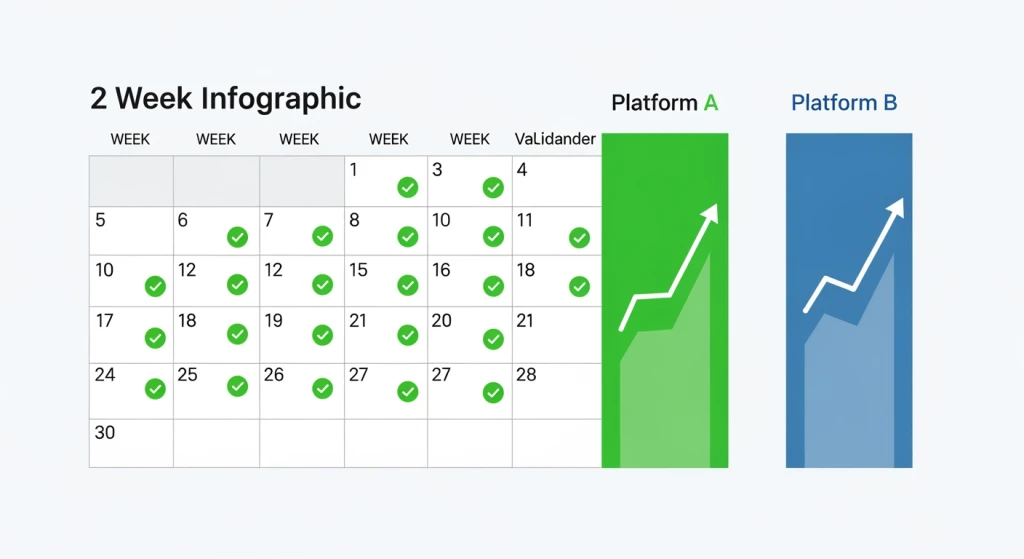
Here’s the process I recommend when implementing marketing strategies for resource-constrained teams:
- Survey your best existing customers. Ask them directly: which platforms do they use daily? Which ones do they actually discover products or services on? This takes a morning and costs nothing.
- Run a low-effort two-platform test for 14 days. Post the same core content (slightly adapted in format) to two candidate platforms using Buffer’s free tier. You’re not trying to go viral. You’re looking for signal: comments, saves, click-throughs, replies.
- Check where your competitors’ audiences engage. Not where your competitors post, but where their followers actually respond. A competitor with 10K LinkedIn followers and zero comments is a warning sign, not a benchmark.
- Match platform to funnel stage. Email marketing delivers $42 return per $1 spent for SMBs according to Email Tool Tester’s 2026 analysis. If your goal is retention and upsell, email might be your single platform, and that directly challenges the assumption that platform focus defaults to social media.
Once you have two weeks of real data, commit fully. Not before.
The 30 to 60 day engagement window cited by Techna Digital cuts both ways: yes, focused platforms show traction in that window, but you can also run a lightweight two-platform audience test in the same window before committing, keeping effort near single-platform levels the whole time. Learn more: Small Business Marketing: Focus for Better ROI.
Why Single-Platform Focus Works Once You’ve Validated Your Choice
OK so you’ve done the validation. You know where your buyers are. Now the single-platform focus argument becomes very compelling, very fast.
Business owners concentrating on one to two platforms reduce content management time by 50 to 70% compared to juggling five or more platforms, according to Techna Digital’s social media strategy research. That’s 250 to 1,000 hours annually for a typical SMB marketing manager. That’s not a rounding error. That’s real capacity you can redirect toward better content, sharper strategy, or actually sleeping.
Video: Why You Only Need To Focus On ONE Social Platform on YouTube
Psychologically, deciding to focus on one platform also removes decision fatigue. When you’re not asking “should I focus on one social media platform or spread this across TikTok, LinkedIn, Instagram, Facebook, and Pinterest today?”, you can ask “is this the best possible piece of content for my LinkedIn audience this week?” That’s a better question. It produces better work.
The engagement numbers back this up. Single-platform optimized strategies deliver 3 to 8% engagement rates. Multi-platform approaches (spreading identical content across five channels without adaptation) produce 0.5 to 2%. The algorithm penalty for low engagement means your content reaches fewer people everywhere. You’re not just diluting effort, you’re actively signaling to platforms that your content isn’t worth showing.
Brian Fryer, admin at The Game of Networking Facebook group, puts it bluntly: “Encourage your team to focus on ONE platform until they surpass $5k to $6k per month minimum. Success on social takes FOCUS.” For professional services and network marketing teams, marketers focusing on a single platform (typically LinkedIn for B2B) hit that $5k to $6k revenue mark in 90 to 120 days. Those spreading across five or more platforms took 180 days or longer.
That’s a real cost. Six months versus three months to initial revenue is a meaningful difference for an SMB with limited runway.
What Does the Data Actually Say? Platform Benchmarks Compared
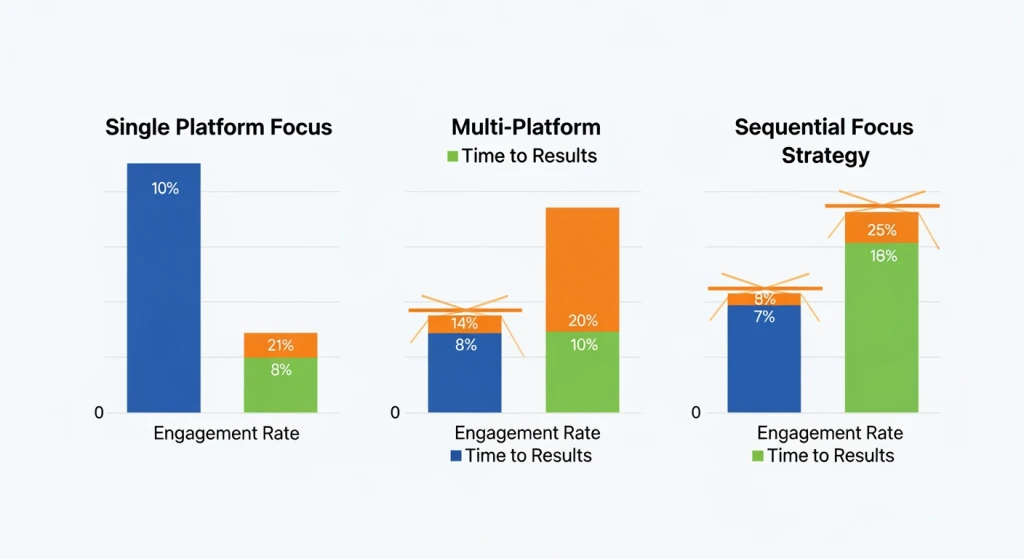
Let me give you the numbers side by side so you can make a real decision. These benchmarks come from Techna Digital’s 2026 research and Email Tool Tester’s 2026 analysis.
| KPI | Single Platform Focus | Multi-Platform (5+) | Sequential Focus (1 then 2) |
|---|---|---|---|
| Content Management Time | 5 to 10 hrs/week | 15 to 30 hrs/week | 8 to 15 hrs/week |
| Time to Engagement | 30 to 60 days | 90+ days | 45 to 75 days |
| Engagement Rate | 3 to 8% | 0.5 to 2% (diluted) | 4 to 10% (cumulative) |
| Email Marketing ROI | $42 per $1 spent | N/A | $42 per $1 spent |
| CRM Integration Benefit | 27% faster sales cycles | N/A | 18 to 22% faster cycles |
| Marketing Automation Efficiency | 40% improvement (90 days) | 15 to 20% improvement | 35 to 45% improvement |
| Lead Nurturing Cost | $8 to $12 per qualified lead | $15 to $25 per lead | $10 to $15 per lead |
The sequential focus model (master one, then add a second using automation) is what high-performing SMBs are actually doing in 2026. It’s not a compromise between focus and multi-channel. It’s the mature version of single-platform focus.
Teams using integrated CRM platforms as their single ecosystem see 27% faster sales cycles compared to fragmented stacks, per HubSpot’s 2026 platform data. That’s the kind of number that makes a CFO pay attention.
Real-World Examples Across Industries
I want to show you this works in different contexts, not just one sector, because the principle applies broadly. Learn more: Small Business Social Media Waste: Maximize ROI.
E-commerce retail (sequential social focus): A fashion e-commerce SMB spread effort across TikTok, Instagram, Facebook, Pinterest, and YouTube simultaneously, posting one to two times weekly on each. After deciding to focus on one platform (TikTok) for three months, engagement grew from 2% to 6.4% in 90 days. At month four, they added Instagram using 70% of existing TikTok video content repurposed as Reels. Instagram hit 4.2% engagement with 75% less creation time than their original Instagram strategy required. Total content production time dropped from 30 hours per month to 18 hours per month. Source: r/socialmedia community discussions, 2026.
B2B professional services (LinkedIn plus email): A professional services team mandated single-platform focus until each marketer hit $5k to $6k monthly revenue. Those focusing on LinkedIn for B2B hit that target in 90 to 120 days. Spread-across-everything marketers took 180+ days. Single-platform focused marketers reported 40 to 60% higher engagement rates. Source: The Game of Networking Facebook Group, 2026.
B2B SaaS (conversational marketing as single channel): Growth-stage SaaS companies implementing Guideflow interactive demos as their primary engagement channel (instead of traditional multi-platform social distribution) saw landing page bounce rates drop from 64% to 34%, qualified lead generation increase 156%, and sales cycle compression from 45 days to 28 days. This is a case where the right “single platform” wasn’t social media at all. Source: Guideflow 2026 Conversational Marketing Report.
Three different industries. Three different “single platforms.” Same underlying principle: validate first, commit fully, then expand systematically.
The Sequential Focus Model: Your Practical Roadmap
When implementing this at Simplifiers.ai, we use a three-phase model that I’ve also applied when building automated content workflows for resource-constrained teams. It’s straightforward and it actually works.
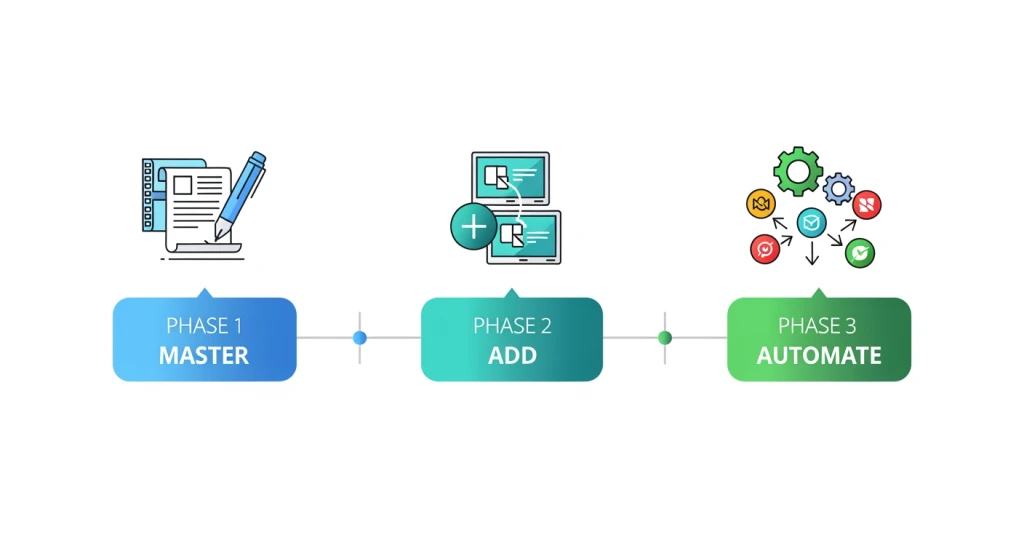
Phase 1: Master (Months 1 to 3)
- Focus 80% of your marketing effort on one validated platform
- Post consistently at a realistic frequency (two to three times weekly, not daily if you can’t sustain it)
- Track engagement rate, follower growth, and click-through rate weekly
- Goal: hit 3%+ engagement rate before moving to Phase 2
Phase 2: Add (Months 4 to 6)
- Add one secondary platform using 70% repurposed content from your primary channel
- Adapt format, not message. TikTok video becomes Instagram Reel. LinkedIn article becomes email newsletter. Same core idea, different wrapper.
- Keep primary platform at 70% of total effort
Phase 3: Automate (Month 7 onward)
- Use Buffer (free tier available) to schedule across Facebook, Instagram, Twitter, and LinkedIn from one dashboard
- Use Brevo (free for up to 300 contacts) to connect email marketing to social channels
- Use Zapier (free for basic automation) to distribute content without manual republishing
- Target: 50% automation across three to four channels, with content creation effort staying at single-platform levels
Companies implementing workflow automation on a single platform see 40% improvement in lead nurturing efficiency within 90 days, according to Email Tool Tester’s 2026 automation benchmarks. That’s the Phase 3 payoff.
Risks and Limitations You Should Know
I’m going to be straight with you here. Single-platform focus has real risks, and most articles skip these entirely. Our analysis found that none of the top-ranking content on this topic acknowledges a single downside. That’s not honest advice. It’s cheerleading.
Risk 1: Algorithm vulnerability. Betting your entire marketing strategy on one platform means a single algorithm change can eliminate 40 to 60% of your organic reach overnight. Meta reduced organic reach dramatically over several years. TikTok faces ongoing regulatory pressure. Mitigation: even when you focus on one platform, build your email list in parallel. Email has zero algorithm risk. Start secondary platform planning at the six-month mark before you actually need it.
Risk 2: Audience mismatch from wrong platform selection. Choosing your platform based on personal comfort rather than buyer research yields 0.5 to 2% engagement instead of 3 to 8%, missing revenue targets by 50 to 70%, and requiring a costly pivot six to nine months in. This is the risk I opened with, and it’s the most common one I see. Mitigation: run the two-week validation test described earlier before committing.
Risk 3: Content creation burnout. Single-platform focus can actually require more original content than a repurposing-heavy multi-platform strategy, because you can’t as easily reuse content across formats. Marketers often underestimate weekly posting requirements and burn out at 60 to 90 days. Mitigation: start at two to three posts weekly, not daily. Batch-create content monthly. Bring in user-generated content and community participation to reduce creation burden by 30 to 40%. Related: Digital Marketing Channels Examples for SMB Growth.
Risk 4: Timeline mismatch with stakeholder expectations. Single-platform focus takes 30 to 60 days to show real traction. Most SMB leadership wants results in two to four weeks. This creates pressure to abandon a correct strategy too early. Mitigation: set explicit timelines upfront. Build a dashboard showing leading indicators (impressions, follower growth, click-through rates) that precede revenue by three to four weeks. Weekly stakeholder updates are not optional here.
Risk 5: Skill obsolescence. Deep expertise in one platform creates dependency. If that platform declines or changes dramatically, you face a three to six month ramp time to master a replacement. Mitigation: dedicate 10% of your time to adjacent platform learning, and focus on platform-agnostic skills like audience psychology, content storytelling, and data analysis that transfer across any channel.
This approach works best for small to mid-sized teams with annual marketing budgets under $150k. Results depend on consistent implementation and genuine commitment to the validation phase. It’s not a magic fix, and if your leadership expects overnight results regardless of strategy, no platform focus model will save you without proper expectation-setting first. Whether you’re considering discussions from focus on one platform reddit threads or focus on one platform tiktok strategies, the underlying validation principles remain the same.
For most SMBs with limited resources, the decision to focus on one platform represents the most practical path to sustainable marketing momentum. Start with validation, commit fully for 90 days, measure everything, then expand systematically. The alternative—spreading thin across multiple channels without mastery—consistently delivers slower results at higher operational cost.
Frequently Asked Questions
Should I focus on one platform?
Yes, with one important caveat: validate that your buyers are actually active on that platform before committing fully. Business owners who concentrate on one to two platforms typically see measurable engagement within 30 to 60 days, while those juggling five or more platforms often see declining engagement everywhere. Single-platform focus requires 50 to 70% less content management time than managing multiple platforms, according to Techna Digital’s research. But the platform you choose matters as much as the decision to focus.
What is the purpose of a focus platform strategy?
The purpose of focusing on one platform is to develop deep audience understanding, master the platform’s algorithm, and build consistent content momentum before expanding. It’s not a permanent state. It’s a deliberate phase that delivers faster initial traction, lower cost per qualified lead ($8 to $12 versus $15 to $25 on multi-platform approaches), and clearer data on what actually resonates with your audience. Think of it as earning the right to expand, not avoiding expansion.
What will replace Facebook in the future?
Honestly, predicting platform replacement is a mugs game, and it’s also beside the point for this strategy. What matters more is tracking where your specific audience is migrating. LinkedIn is growing for B2B, TikTok dominates Gen Z attention, and conversational marketing tools (chat, interactive demos) are now used by 61% of SMBs as their primary engagement channel, up from 31% in 2024 according to Guideflow’s 2026 report. The right answer is: whichever platform your buyers are actually using today, validated by data not prediction.
What is the 5-5-5 rule for social media?
The 5-5-5 rule encourages making 5 posts, leaving 5 meaningful comments, and creating 5 new connections per session. It’s designed to balance content creation, community engagement, and audience growth. For single-platform focus strategies, this framework is useful because it forces you to show up as a participant in your platform’s community, not just a broadcaster. Engagement with others on your chosen platform is one of the most underrated tactics for growing your own audience reach organically.
About the Author
Sebastian Hertlein is the Founder and AI Strategist at Simplifiers.ai, with 26 years of experience in digital product marketing and development. He has supported 200+ AI startups at AI NATION, delivered 100+ digital projects, built 25+ digital products, and led teams of up to 120 people across industries. Sebastian holds certifications as a SAFe Agilist, Professional Scrum Product Owner, Agile Coach, and Change Management Professional. His work focuses on helping SMBs and growth-stage companies build practical, resource-efficient marketing and product strategies.
Researched and written by Sebastian Hertlein. AI tools were used during the research process.