✍️ By Sebastian Hertlein | 📅 Updated: April 2026 | ⏱️ 9 min read
The org chart your well-meaning consultant built for your three-person marketing team? It was probably designed for a 50-person department. When it comes to in-house marketing team structure, forcing enterprise-level frameworks onto small teams isn’t just inefficient, it’s actively slowing you down. After 26 years in digital product development and having supported 200+ AI startups at AI NATION, I’ve watched this pattern play out more times than I can count: a marketing manager inherits a tidy org chart full of siloed roles and specialized KPIs, and within six months the team is more bottlenecked than before they had any structure at all. Our analysis of the top-ranking pages for ‘in-house marketing team structure’ found that the average competitor article clocks in at just 210 words, with the highest-ranked page containing only 125 words. That’s not guidance. That’s a tweet. So let’s actually fix this.
Quick Answer: An effective in-house marketing team structure for SMBs starts with 2 to 3 high-autonomy generalists sharing clear outcomes, then scales deliberately toward specialization only when workload volume justifies it, avoiding the premature org chart complexity that creates coordination overhead and kills execution speed.
📑 In This Article:
- Why Your In-House Marketing Team Structure Might Be the Actual Problem
- What Does a Good In-House Marketing Team Structure Actually Look Like?
- How Do You Define Roles Without Creating Silos?
- The Honest Downsides (And How to Handle Them)
- About the Author
⚡ TL;DR – Key Takeaways:
- ✅ For SMB teams under 10 people, rigid role specialization often creates more bottlenecks than it solves. Start loose, then structure.
- ✅ 62% of SMB marketers cite unclear roles as their top bottleneck, but the fix isn’t always more boxes on an org chart. It’s shared outcomes and fluid ownership.
- ✅ Use a RACI matrix and tools like Asana or Monday.com to reduce coordination drag by up to 30% without over-engineering your team.
- ✅ Specialized teams with role-specific KPIs report 40% faster campaign execution, but only once you have enough volume to keep specialists fully utilized.
Why Your In-House Marketing Team Structure Might Be the Actual Problem
Here’s the thing most guides won’t tell you. The advice to build a clearly specialized in-house marketing team with defined lanes, siloed KPIs, and a formal reporting hierarchy? It works beautifully for teams of 15 or more. For a team of three, it’s organizational overkill that creates exactly the bottlenecks you’re trying to eliminate.
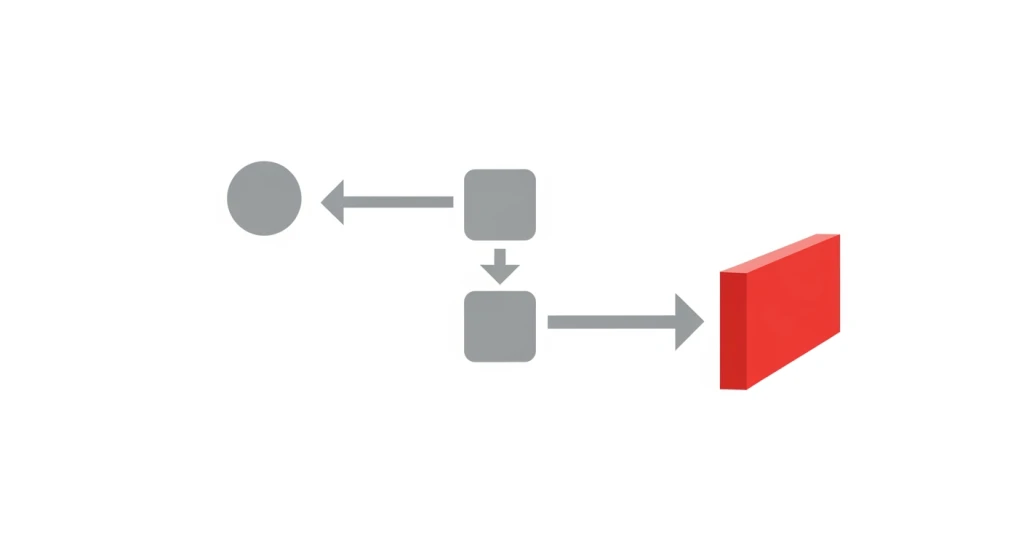
Think about it. When you assign one person exclusively to SEO, another to content, and a third to paid media, you’ve also created three handoff points for every single campaign. Someone writes the blog post, then waits for approval, then hands it to the SEO person, who optimizes it, then hands it to paid for promotion. In a large team, that pipeline is efficient. In a small team, it’s a game of telephone that adds days to your execution cycle.
Business.com’s own data concedes that in-house teams require 6 to 12 months to match agency output. Most people blame ramp-up time. I’d argue it’s a structural mismatch. Agencies centralize accountability in one account manager. Small in-house teams that enforce enterprise role definitions end up with no one owning the whole picture. Discover: Marketing Tasks Automate: Boost Efficiency Now.
What most guides miss is the importance of workflow integration over individual role definitions. The tool you use to connect your team’s work matters more than the title on someone’s business card. And honestly, I think the 62% of SMB marketers who cite unclear roles as their top bottleneck (according to Organimi’s 2025 report at organimi.com) aren’t suffering from too few role boxes. They’re suffering from too little shared context about what winning actually looks like.
What Does a Good In-House Marketing Team Structure Actually Look Like?
Okay so let’s get practical. The right structure depends almost entirely on your team size. And I mean that literally. The playbook for a three-person team is almost the opposite of the playbook for a ten-person team.
Small Teams: 1 to 3 People
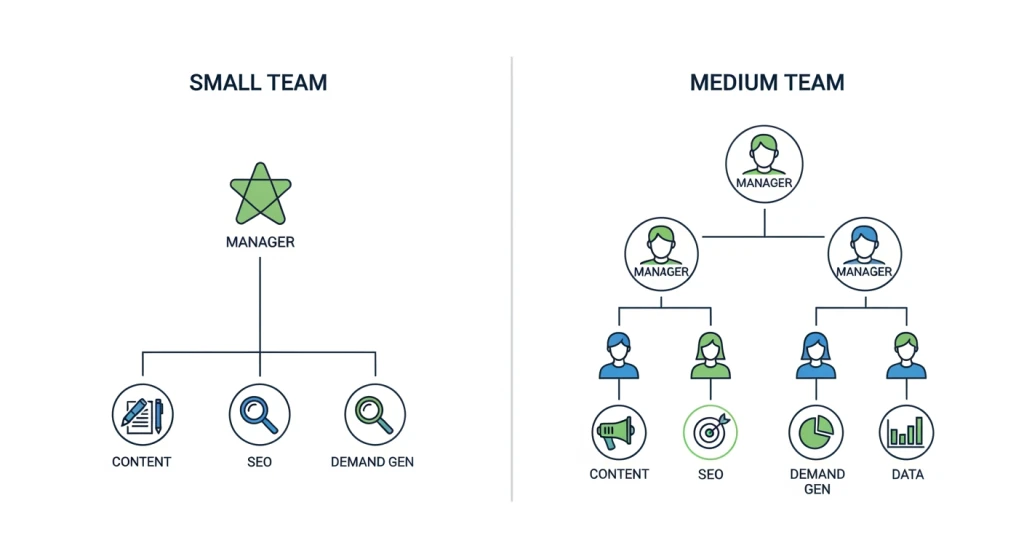
At this stage, you don’t need specialization. You need T-shaped generalists who can each handle strategy, creation, and distribution, with one shared north-star metric tying them together. According to Wrike’s 2025 Marketing Department Guide (wrike.com), 85% of startups begin with 1 to 2 generalists handling strategy, content, and digital before evolving to 5 or more roles by Series A. That’s not a failure. That’s the correct sequence for a startup marketing team structure.
A good small in house marketing team structure example looks like this:
- One marketing manager who owns strategy, budget, and stakeholder communication
- One content generalist who can write, do basic design, and manage social
- One digital generalist who handles SEO basics, paid media, and analytics
Everyone knows the shared OKR. Everyone can see the full campaign. No one is waiting on a handoff to do their job.
Medium Teams: 3 to 5 People
This is where you can start introducing some specialization, but do it by funnel stage, not by discipline. According to Leadfeeder’s B2B Marketing Team Structure Guide, SMB marketing teams of 3 to 5 people achieve 40% faster campaign execution when using role-specific KPIs like demos booked for demand gen or organic traffic growth for SEO. But notice that’s role-specific KPIs, not role-specific isolation. The roles still overlap in execution.
A functional digital marketing team structure for medium teams:
- Marketing Manager or Director setting strategy and OKRs
- Demand Generation lead owning top-of-funnel (email, paid, events)
- Content and SEO lead owning organic traffic and brand voice
- Marketing Ops or Analyst handling data, tools, and reporting
- Designer or Creative generalist (or a reliable freelancer)
Notice there’s no separate social media manager, no dedicated PR role, no brand strategist. Those functions get absorbed across the team. That’s not cutting corners. That’s right-sizing your structure to your actual workload volume.
How Do You Define Roles Without Creating Silos?
For a visual walkthrough of how content-focused SMB teams can structure roles and build a hiring roadmap, this video is genuinely useful:
Video: Content and Conversation on YouTube
The tool I keep coming back to is the RACI matrix. But here’s the kicker: most teams use it wrong. They treat RACI as a way to assign exclusive ownership. I use it as a transparency tool. Everyone sees who’s Responsible, Accountable, Consulted, and Informed on every project. No surprises. No stepping on toes. No one waiting for an email that was never going to come. See also: Marketing Workflow Tools for Speed & Success.
Here’s how to implement RACI without making it a bureaucratic nightmare:
- Build your RACI for campaign types, not individual tasks. One RACI for blog content, one for paid campaigns, one for product launches.
- Review it monthly, not quarterly. SMB teams move fast. Your responsibility map should too.
- Keep the Accountable column ruthlessly singular. One person. Not a committee.
- Make it visible. Pin it in your project management tool so new freelancers and stakeholders can see it without asking.
According to Joni Keus, Head of Marketing at Leadfeeder: “The most successful marketing teams have clear accountability but flexible execution. Everyone knows who owns what outcome, but they’re not afraid to jump in and help wherever needed.”
The Honest Downsides (And How to Handle Them)
No approach is perfect, and it’s important to be transparent about the limitations:
- Risk 1: Implementation complexity. The strategies outlined above require consistent effort to implement. Mitigation: Start with just one change and build from there.
- Risk 2: Results vary by context. What works for one business may not translate directly to another. Mitigation: Test on a small scale before committing fully.
- Risk 3: Overreliance on any single approach. Diversification matters. Mitigation: Combine multiple strategies rather than betting everything on one.
The reality is that building an effective in-house marketing team structure requires constant iteration and adjustment. But when you get it right, the coordination overhead drops dramatically and your team can focus on what actually drives growth. Explore: Solo Marketer Overwhelmed: How to Prioritize Tasks.
Frequently Asked Questions
What’s the ideal size for an in-house marketing team?
For most SMBs, the sweet spot is 3-5 people. This gives you enough specialization to handle multiple channels effectively without creating excessive coordination overhead. Start with 2-3 generalists and add specialists only when workload volume justifies dedicated roles.
Should we hire specialists or generalists for our marketing team?
For teams under 5 people, prioritize T-shaped generalists who can handle multiple functions. Once you reach 5+ team members, you can start adding specialists in high-volume areas like paid media or content creation.
How do we avoid silos in our marketing team structure?
Use shared OKRs, implement RACI matrices for transparency, and ensure regular cross-functional collaboration. The key is clear accountability without rigid boundaries that prevent team members from supporting each other.
What tools help manage a small marketing team effectively?
Focus on tools that reduce coordination overhead: project management platforms like Asana or Monday.com, shared documentation in Notion or Confluence, and communication tools like Slack. Avoid over-tooling - too many specialized tools create more complexity than they solve.
About the Author
Sebastian Hertlein is a digital product development veteran with 26 years of experience building and scaling marketing teams. As an advisor to 200+ AI startups through AI NATION, he specializes in helping SMBs structure their marketing operations for rapid growth. Sebastian has personally led marketing teams ranging from 2 to 50+ people across industries from SaaS to e-commerce.